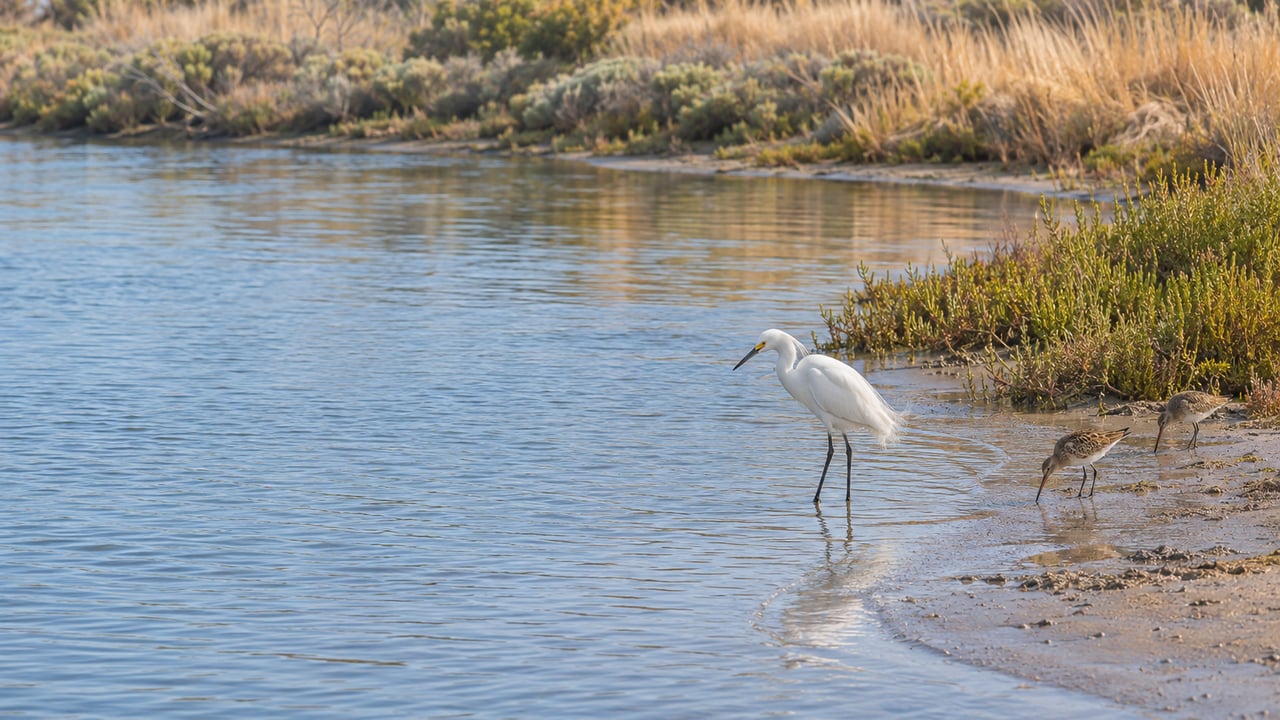
The western sandpipers are back on Upper Newport Bay. The Newport Bay Conservancy describes them as "flying clouds," flocks of hundreds or thousands that twist and turn together, flashing their white undersides as they bank. They are part of a winter crowd that comes down from breeding grounds in the Arctic reaches of Alaska and western Canada. The Conservancy says up to 30,000 birds can be seen at the Back Bay on a single winter day, out of roughly 200 species that visit over the year.
Where they are and what they are doing depends on the water level, and the water level follows the tide table. From now until most of the migrants leave in February and March, the Back Bay works on a tidal schedule. This winter, the highest tides of the season fall during Thanksgiving week and again around Christmas.
The bay almost became something else. The California Department of Fish and Wildlife records that by the late 1960s there were plans to turn Upper Newport Bay into a luxury marina with waterfront homes and private docks. Local residents pushed for conservation, and in 1975 the Fish and Game Commission designated the area a State Ecological Reserve. The mudflats the sandpipers land on today are the result of that decision.
Low water belongs to the long bills
When the tide is out, the mudflats are uncovered and the shorebirds feed. The Conservancy's account of the season describes thousands of them feeding hard at low tide to regain up to half the body weight they lost on the flight south. Bill length sorts them by depth. Marbled godwits and long-billed curlews probe deep into the mud, while plovers and the smaller sandpipers work closer to the surface.
Vista Point, a grassy area with benches and signs about the bay's wildlife and habitat, sits where the Mountains to Sea Trail and Bikeway meets Eastbluff Drive. Back Bay Drive runs along the water from Shellmaker Road, where the Mountains to Sea Trail and Bikeway begins. Sea & Sage Audubon lists shorebirds, ducks, grebes, herons and egrets as the seasonal draws on its Back Bay walk, along with Black Skimmers and terns.
High water moves the birds into the marsh
As the tide comes in and covers the mud, the shorebirds stop feeding and rest. The ducks then take over the water's surface and feed among the cordgrass and pickleweed. The Conservancy's naturalists also note that about two hours after high tide, many of those ducks head for the freshwater inlets or the freshwater pond in the Big Canyon area to bathe, rest and socialize. If you know when high tide is, you can be at the Big Canyon end of Back Bay Drive when the ducks start arriving.
High water also explains the bay's best-known resident. The Ridgway's rail is endangered, and the Back Bay holds the largest subpopulation of the species left in the United States. The highest count, taken in 2005, tallied more than 170 breeding pairs. The rail depends on tall cordgrass. It weaves a floating platform nest in the lower marsh, the part that floods at high tide, so the nest rises and falls with the water. It then bends the surrounding grass tips into a canopy that holds the nest in place during high spring tides.
Do not expect to see one. The Conservancy says many of its own naturalists never have. The rail flies poorly and moves on foot under cover. When it does come out, it is most likely to be seen early in the morning, searching the tidal debris at the marsh edge for snails, crabs and insects. The Conservancy asks visitors to look from marked trails and designated water areas and to stay out of the salt marsh and its side channels.
This winter's highest water lands on the holidays
The California Coastal Commission calls king tides the highest predicted tides of the year. It lists this season's statewide dates as November 24 through 26, December 23 through 25, and January 21 and 22. The first set runs Tuesday through Thursday of Thanksgiving week and ends on Thanksgiving Day. The second runs Wednesday through Christmas Day. The Commission's site has a tide map with local dates and times, and since the timing matters here, check the Newport Bay times there before you head out.
At a king tide the marsh floods higher than at any other point this season, and the shorebirds rest while the mud is covered. Plan the holiday visit around the trails and overlooks. OC Parks lists the Peter and Mary Muth Interpretive Center as open Tuesday through Sunday from 10 a.m. to 4 p.m. and closed Mondays and major holidays. Vista Point, Back Bay Drive and the Mountains to Sea Trail are where you can watch the bay fill. The county also describes winter migration as the season when as many as 35,000 birds may use the bay at one time.
Big Canyon, partway through its restoration
Big Canyon is where the ducks go after high tide, and it is also where the Conservancy is restoring the canyon itself. The Conservancy describes it as the largest remaining natural canyon on the east side of Newport Bay. It is a 60-acre open space where Big Canyon Creek drains a 1,300-acre watershed into the Ecological Reserve. In the 1950s and 1960s, dredge fill was stockpiled in the creek, which raised the canyon floor and pushed the creek into a channel along the north side. Phase III, the final phase, restores 14 acres of historic salt marsh and adds transitional wetland habitat. According to the Conservancy, the project received its final round of funding from the state Wildlife Conservation Board in August 2025.
The Orange County Register reported in September 2025 that construction on this last phase was scheduled to begin that month and that wetland plants would be seeded once the work was done. During construction, the Conservancy closed the through-trails in Big Canyon Nature Park from the Back Bay Drive parking lot to Jamboree, giving the end of August 2026 as the likely reopening. Back Bay Drive and the Big Canyon parking lot stayed open throughout. If you plan to walk through to Jamboree, check the Big Canyon project page first. The lot is the meeting point for the Sea & Sage walk listed below.
The Conservancy runs a Big Canyon Bird Survey, usually on the third Thursday of the month. It is a two- to three-hour outing that logs the canyon's birds to the Diversity of Upper Newport Bay project on iNaturalist, and the Conservancy says it suits beginners and experienced birders alike. November's third Thursday is publication day. December's falls on the 17th, and anyone who wants to join is asked to contact the Conservancy first.
Dates on the trail and the water through January
The bay looks different from a kayak than from the bluff, and the Conservancy's guided tours launch from the Newport Aquatic Center, next to North Star Beach. Guests paddle double kayaks, no experience is needed, and a volunteer naturalist starts with a short safety lesson. Parking is free and there are restrooms on shore. The fee is $25 per person this season, and the Conservancy notes it has kept that rate for many years. Back Bay Science Center on Shellmaker Island is a good place to start indoors. Shell mining for calcium continued on the island into the 1980s, and the center is now free and open to the public most Sundays. Here is the calendar from this weekend through the Friends Tour on January 9.
- Conservancy kayak tours, 10 a.m. to noon: November 21, 22, 28 and 29; December 5, 6, 13, 19, 20, 26 and 27.
- Back Bay Science Center open house, Sundays 10 a.m. to 2 p.m.: November 22 and 29; December 6, 13, 20 and 27. Drop in any time to see the facility and the Shellmaker trail.
- Sea & Sage Audubon Upper Newport Bay bird walk: Sunday, November 29, 8 to 11:30 a.m., meeting at the Big Canyon parking lot on Back Bay Drive.
- Conservancy Friends Tour: the second Saturday of each month from October through March, which puts the next two on December 12 and January 9. It is a free 90-minute walk along Back Bay Drive that starts at Vista Point.
- Sea & Sage pontoon boat trip: Wednesday, December 16. Check in at 8:15 a.m. for an 8:30 departure from the Sea Scout Base, 1931 West Coast Highway. Tickets are $25, and advance registration is required.
- Coastal Christmas Bird Count: Sunday, January 3, covering the coast from Seal Beach south to Newport Bay and inland to parts of Santa Ana and Garden Grove. Participants are asked to contact the compiler with their birding experience and contact information.
Two of those dates follow a king tide closely. The November 28 and 29 kayak tours and the November 29 bird walk come the weekend right after the Thanksgiving tides, and the January 3 count comes less than three weeks before the January 21 and 22 set. By February and March, the Conservancy says, many of the migrants have started back north to breed.
The Back Bay is part of what makes the Newport Beach neighborhoods around it, from Eastbluff to the bluffs along Back Bay Drive, feel the way they do. If you would like to talk about homes near Upper Newport Bay or anywhere else along this coast, Trey Dewey is glad to compare notes. Let's Connect.